A stellar visit by Professor Roy Kerr
1 December 2025
REGULUS // ISSUE 3 // NOVEMBER 2025
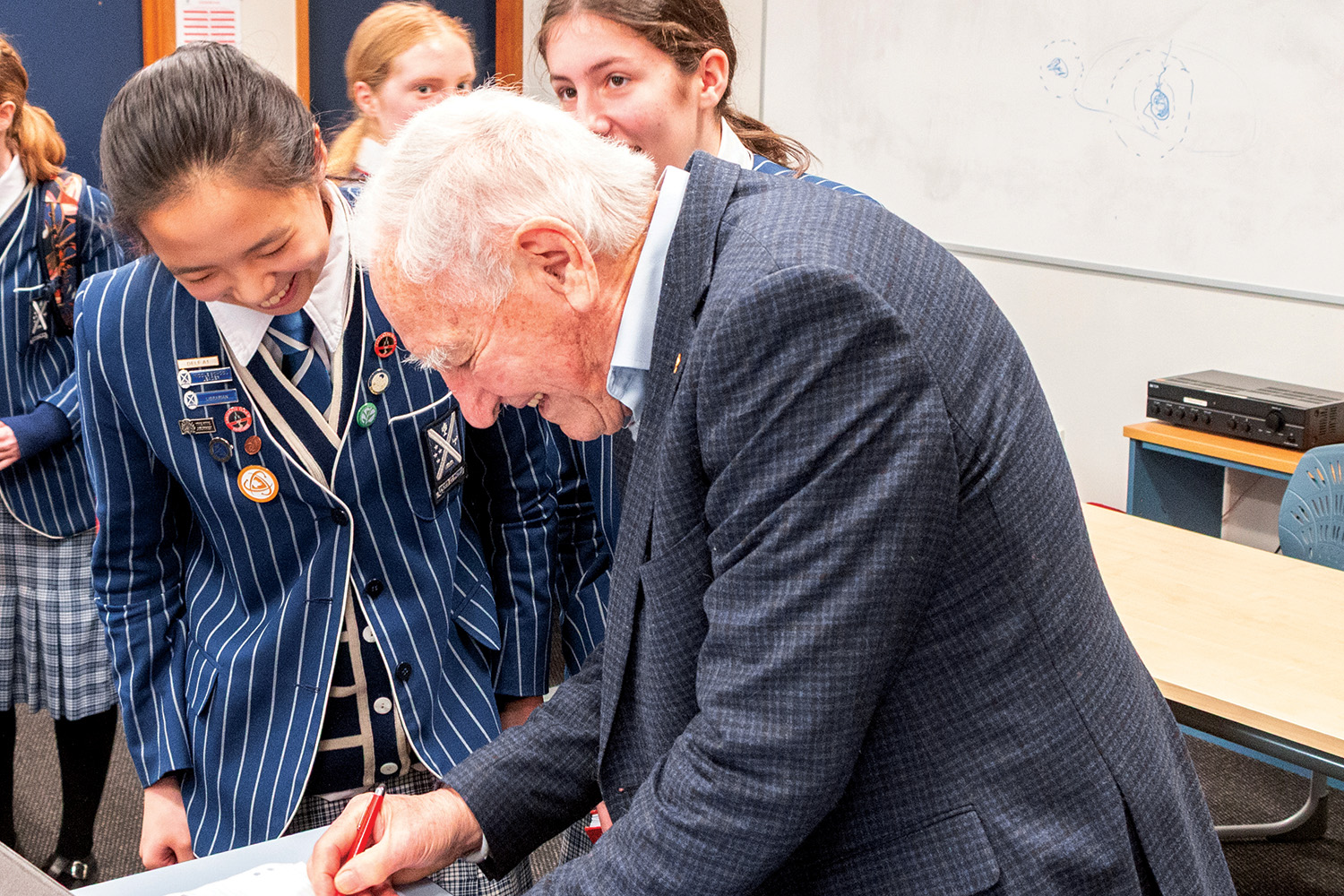
Members of the Mathematics Club were starstruck during a visit by Professor Roy Kerr (OC 1950), with students lining up to receive an autograph from one of New Zealand’s most distinguished mathematicians and physicists, whose mathematical insight has shaped how scientists understand the universe.
Best known for discovering the Kerr solution to Einstein’s equations – a major breakthrough in astrophysics which describes rotating black holes – Roy has received many prestigious accolades for his work, including the Albert Einstein Medal, the Crafoord Prize (often considered the Nobel equivalent for fields not covered by the Nobel Prizes), the Rutherford Medal, being appointed a Companion of the New Zealand Order of Merit (CNZM), and most recently the Dirac Medal, another companion to the Nobel Prize, which he will receive in Italy early next year.
The 91-year-old’s presentation to the students was both deeply engaging and genuinely funny, as he told the students stories about his work and his time at the College, where he was Dux in his sixth form year (now Year 12).
When he started at the College in 1947, both Roy and St Andrew’s were going through some tough post-war times.
After Roy’s father returned from the Second World War where he had served under St Andrew’s College Rector, Joseph Mawson (1934–1947), he started a rubber band factory on the outskirts of Christchurch, where Roy’s affinity for numbers was honed while counting rubber bands into bags once he got home from school.
“Our house was basically a shed, with all the factory machines inside. I slept in a lean-to and when it rained outside it rained inside too. I didn’t take many friends home. It was all very strange.”
Roy remembers excellent teachers like Mrs Pocock and the Dowling brothers at St Andrew’s, but there were no Science teachers in the beginning. Then his good, young Mathematics teacher went off to Cambridge University to get a degree.
“The subject was taken over by a Religious Education teacher who didn’t know anything about maths at all. I just pottered along by myself. Later on, I wanted to sit for a university scholarship in Additional Mathematics Calculus but there was no one to teach it. Eventually I was sent to Jack Lester, a tutor at the University of Canterbury, once a week, who had been an adult student at St Andrew’s when he was well over 20.”
After graduating from the University of Canterbury, Roy won a scholarship to Cambridge University in the UK to complete his PhD. He eventually settled at the University of Texas, and found himself at the heart of an exciting time in astrophysics, with data from radio telescopes unlocking new insights into black holes, quasars, and singularities.
Roy’s deep understanding of geometry, calculus, and new methods for solving simultaneous differential equations (with up to 10 unknowns) enabled him to find a general solution to Einstein’s equations for rotating black holes, phenomena elegantly described by Kerr Geometry.
His most recent paper published in 2023, Do Black Holes Have Singularities?, was the most read scientific paper for several months.
As he reflects on his life and work, Roy believes his academic aptitude may have come from his grandmother.
“She was a pretty bright woman, who graduated from the University of Canterbury in the 1890s with a double first in English and French, then became a teacher and also tutored in Mathematics.”
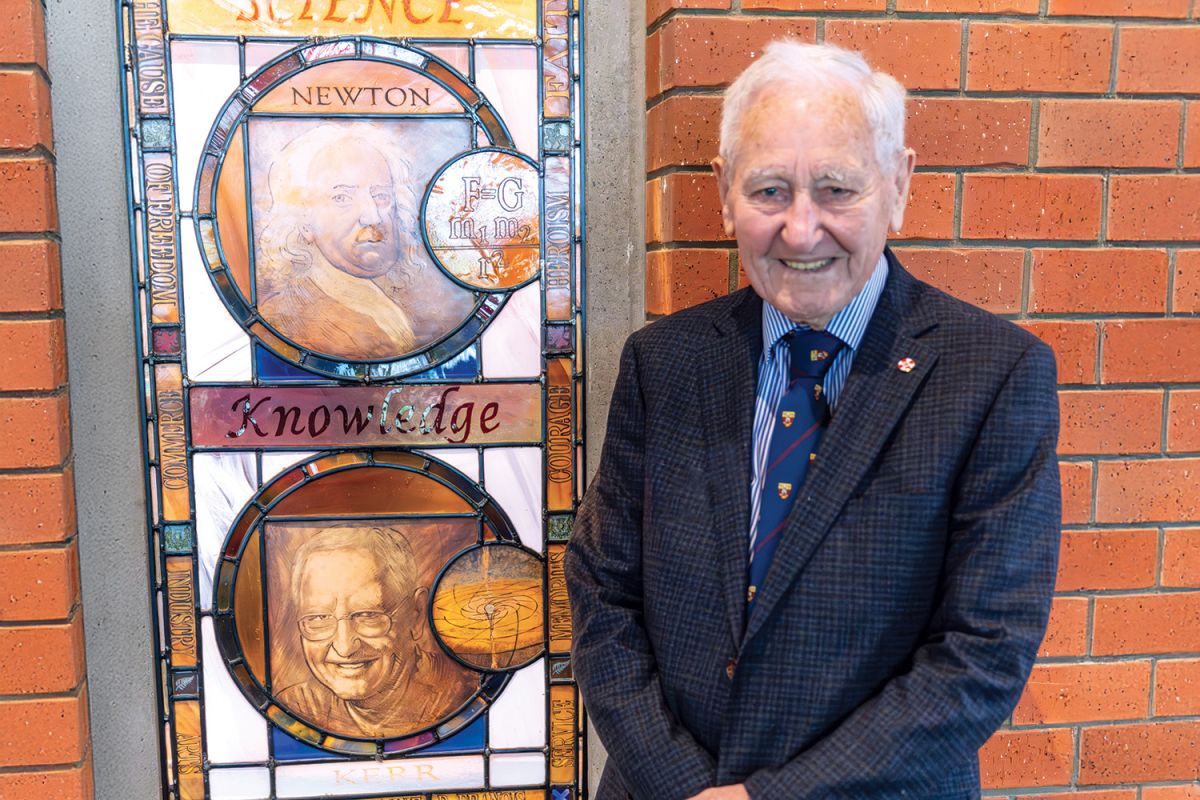
The incredible career and outstanding achievements of one of St Andrew’s most celebrated Old Collegians have also been recognised by the College, with Roy’s image appearing in a stained-glass window in the Centennial Chapel, alongside Da Vinci, Rutherford, and Newton.
Related Posts