Relaunching PERMA V: Our Framework for Well-being
27 January 2026
Written by Head of Well-being, Kerry Larby
At the start of this year, St Andrew’s College reached an important milestone. Under our Rector, Mark Wilson’s leadership, our new strategic plan builds on our existing strengths by clarifying and streamlining the structures that guide our work. One of the key elements shaping our direction is PERMA‑V, our College framework for well‑being. This week, we reintroduced PERMA‑V to all College staff and shared a guide outlining how we bring each pillar to life. Together, we begin a refreshed and unified approach to well‑being across the school.
PERMA‑V gives us a shared language and practical tools to understand and support well-being in everyday school life. Many staff expressed a renewed sense of purpose this week, and were energised by what this shared direction will make possible. This relaunch builds on the commitment we made seven years ago and sets a clear path for the years ahead.
Why a Well-being Framework Matters
Well‑being is a word we use often, yet it is a concept that can easily be misunderstood or oversimplified. Today’s children and adolescents are growing up in a world marked by complexity, pressure, and rapid change. While good intentions matter, they are not enough on their own. To support students effectively, schools need a clear and coherent framework that guides their practice.
A shared framework helps us:
Speak a common language with our ākonga and whānau
Avoid fragmented or reactive responses
Ground our practice in research
Build consistency across classrooms, year levels, and co‑curricular programmes
Education aims to promote human flourishing. It makes sense, then, to offer students a simple way to understand the building blocks of well-being.

What is PERMA-V?
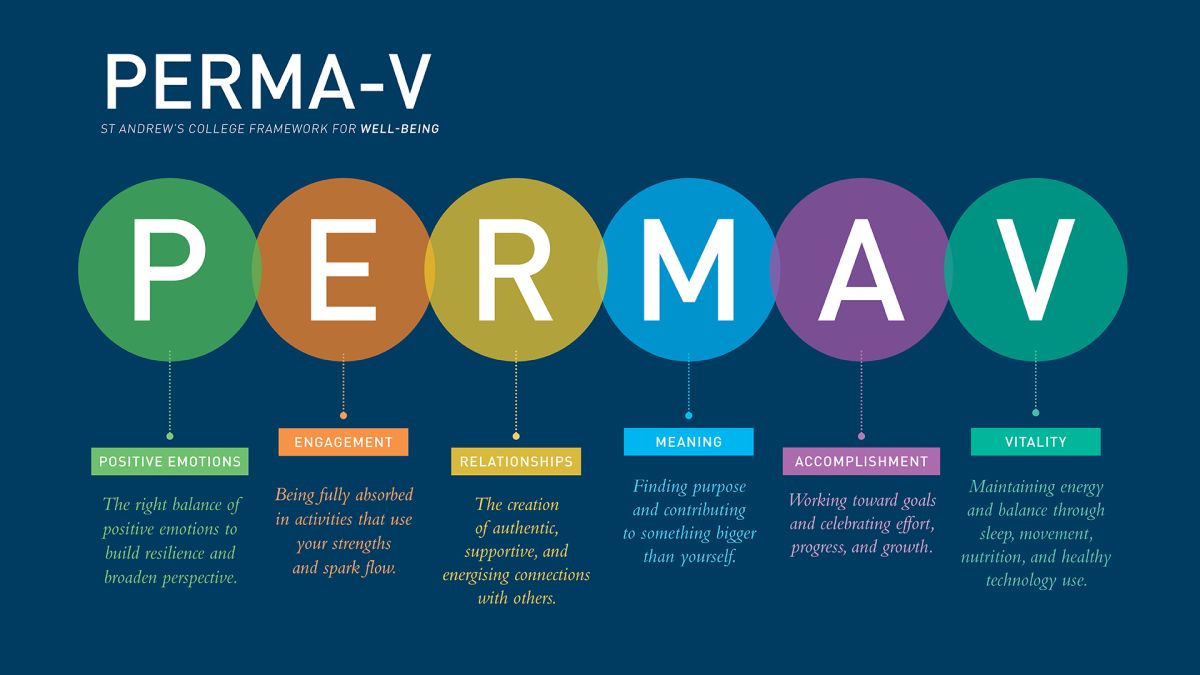
PERMA originates from Professor Martin Seligman, whose early work explored learned helplessness before shifting toward understanding what enables people to flourish. Building on psychological, philosophical, and spiritual traditions, he organised the components of human flourishing into a clear and practical model. The PERMA model has since been expanded by positive psychology practitioners to include a sixth pillar: Vitality.
According to this work, humans flourish when they experience:
Positive emotions
Engagement
Relationships
Meaning
Accomplishment
Vitality
PERMA‑V brings these elements together in a way that is easy to teach, easy to talk about, and easy to apply in daily school life.

Why PERMA‑V for StAC?
Seven years ago, St Andrew’s College committed to PERMA‑V as our well-being framework—and we believe it remains the right choice for our kura. PERMA‑V is:
Research-informed and globally recognised: Used in schools, universities, and clinical settings around the world, with a growing evidence base.
Multidimensional and holistic: It reflects the full richness of human flourishing—emotional, cognitive, spiritual, social, and physical.
Actionable and measurable: Each pillar includes strategies that can be taught, practised, and evaluated.
Aligned with education: The pillars mirror the heart of great teaching—meaningful engagement, strong relationships, and purposeful growth.
Free from unhelpful binaries: It recognises accomplishment and growth as a core part of well-being, not something in conflict with it.
Our relaunch of PERMA‑V signals a renewed commitment to equipping our students—and community—with a framework that is simple, practical, and grounded in what research tells us helps humans flourish.
In the weeks ahead, I look forward to sharing our implementation plan and offering deeper insight into each of the PERMA‑V pillars. My hope is that this journey feels clear, purposeful, and encouraging for all of us as we continue building a culture where every student can flourish.
Related Posts